Holding a Temporary Visa in Australia? Plan Your Next Step Towards Study

Information checked on 10 October 2026. General information only, not migration advice.

If you are in Australia on a Working Holiday, Visitor, Temporary Graduate or other temporary visa and you are thinking about study at SSBT, the rules for applying have changed. This guide helps you plan your next step.

Who this affects

From 2 October 2026, holders of the temporary visas listed below cannot apply for a Student visa (subclass 500) while in Australia. Familiar examples include Working Holiday, Visitor and Temporary Graduate visa holders.

The official list has 17 entries. Subclass 482 appears twice, once for each stream.

Subclass Visa
400 Temporary Work (Short Stay Specialist)
403 Temporary Work (International Relations), Domestic Worker (Diplomatic or Consular) stream only
407 Training
408 Temporary Activity
417 Working Holiday
457 Temporary Work (Skilled)
462 Work and Holiday
482 Skills in Demand
482 Temporary Skill Shortage
485 Temporary Graduate
600 Visitor
601 Electronic Travel Authority
602 Medical Treatment
651 eVisitor
771 Transit
988 Maritime Crew
995 Diplomatic (Temporary), where granted under the criteria in Division 995.2

Source: LIN 26/102 (F2026L01348). Check the instrument for the exact wording.

What this means

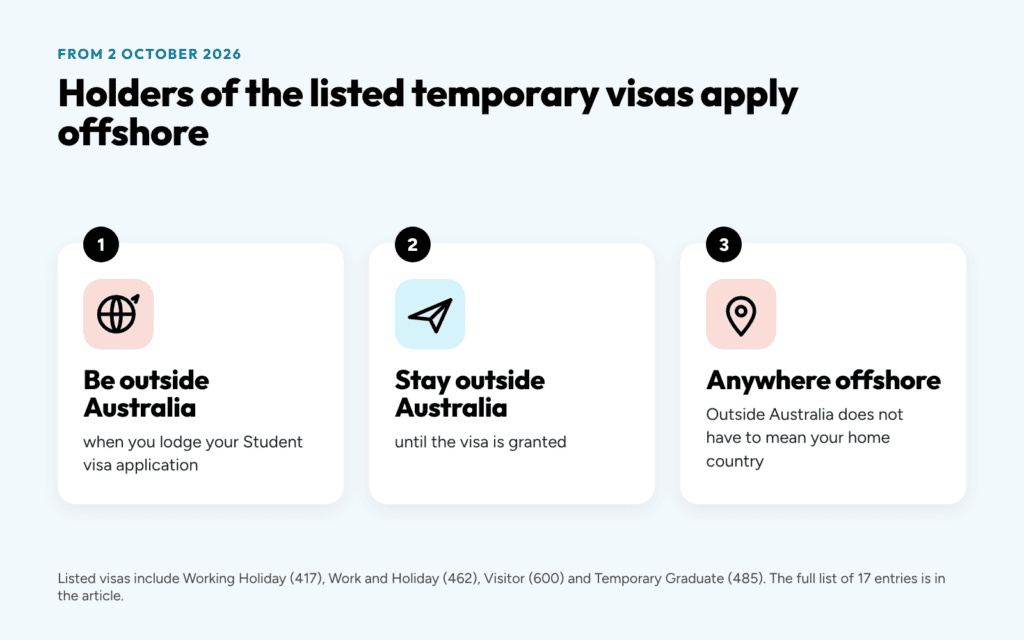
If you hold one of these visas and want to study in Australia, you need to apply from offshore, which means outside Australia. You also need to be outside Australia when the visa is granted.

Offshore means anywhere outside Australia. It does not have to be your home country.
Plan before you apply
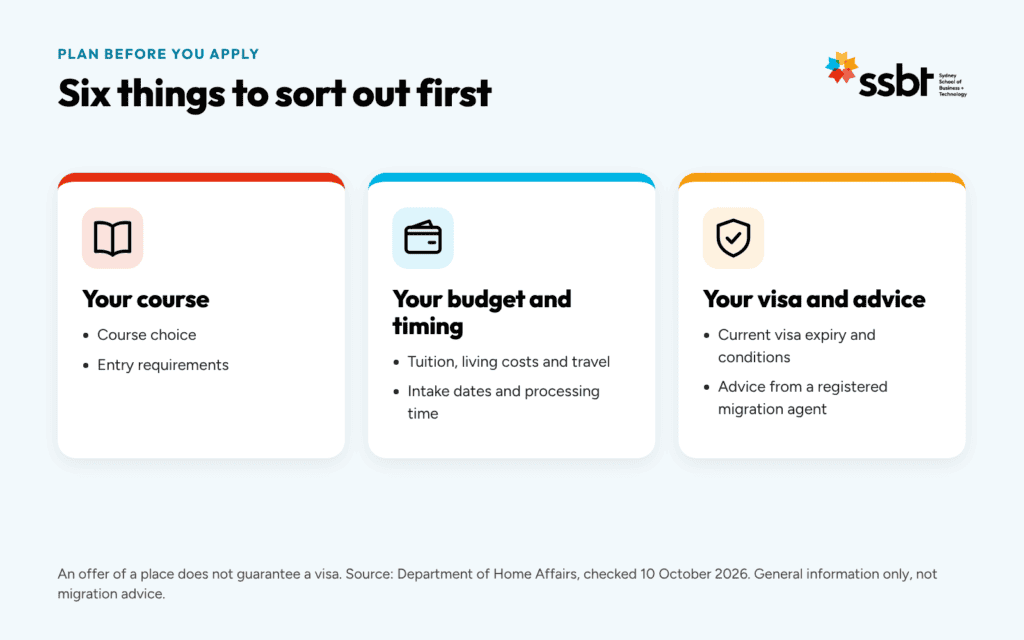
  • Course choice: choose a course that fits your study and career goals.
  • Entry requirements: check academic and English requirements for the course.
  • Finances: plan for tuition fees, living costs and travel.
  • Timing: think about intake dates, how long the application may take and when you need to leave Australia.
  • Your current visa: check its expiry date and conditions.
  • Professional advice: speak to a registered migration agent or an Australian legal practitioner about your situation.

Course packages

Some students study two or more courses in a row, such as a diploma followed by an advanced diploma. This is called a course package. A package is an education option. It does not change where you need to be when you apply.

If you are considering a package, ask:

  • Which qualifications and providers are included?
  • How long is each course, and the whole package?
  • What is the total cost?
  • What are the entry requirements for each course?
  • Is any credit formally approved, and for which units or subjects?

SSBT courses range from certificates to graduate diplomas across Business, IT, Engineering, Hospitality and Early Childhood. Ask us which packages are currently offered and what each one involves.

Talk to us

Explore SSBT courses at ssbt.edu.au or talk to an adviser at 02 9249 7800 or info@ssbt.edu.au.

An offer of a place does not guarantee a visa.

Official sources

  • Department of Home Affairs, Changes to Student visa applications factsheet: immi.homeaffairs.gov.au
  • Department of Home Affairs, Student visa (subclass 500) page: immi.homeaffairs.gov.au
  • Migration Amendment (Student Visa Reform) Regulations 2026 (F2026L01347)
  • Migration (Student Visa Applications to Be Made from outside Australia) Instrument 2026, LIN 26/102 (F2026L01348)
  • Exemptions amendment instrument, LIN 26/087 (F2026L01349)

Legislation is published on the Federal Register of Legislation at legislation.gov.au.

This article is general information, checked on 10 October 2026. It is not migration or legal advice. Rules can change, so check the official sources above before you act. For advice about your own situation, speak to a registered migration agent or an Australian legal practitioner.


Sydney School of Business and Technology (SSBT) · ssbt.edu.au · info@ssbt.edu.au · 02 9249 7800
CRICOS Provider Code 02140E · RTO No. 90438
Can You Apply for Another Student Visa in Australia? Understanding the Exemptions

Information checked on 10 October 2026. General information only, not migration advice.

Many SSBT students ask us what happens if they need more time, or if they want to continue to a higher qualification. This guide explains the exemptions that may let some students apply for another Student visa while in Australia.

Since 2 October 2026, most Student visa (subclass 500) holders need to be outside Australia (offshore) to apply for another Student visa. Some can still apply in Australia (onshore) because an exemption applies. Here are three common questions.

Meeting an exemption means you may be eligible to apply in Australia. It is not an automatic extension and it does not guarantee a visa grant.

“I failed subjects and need more time”

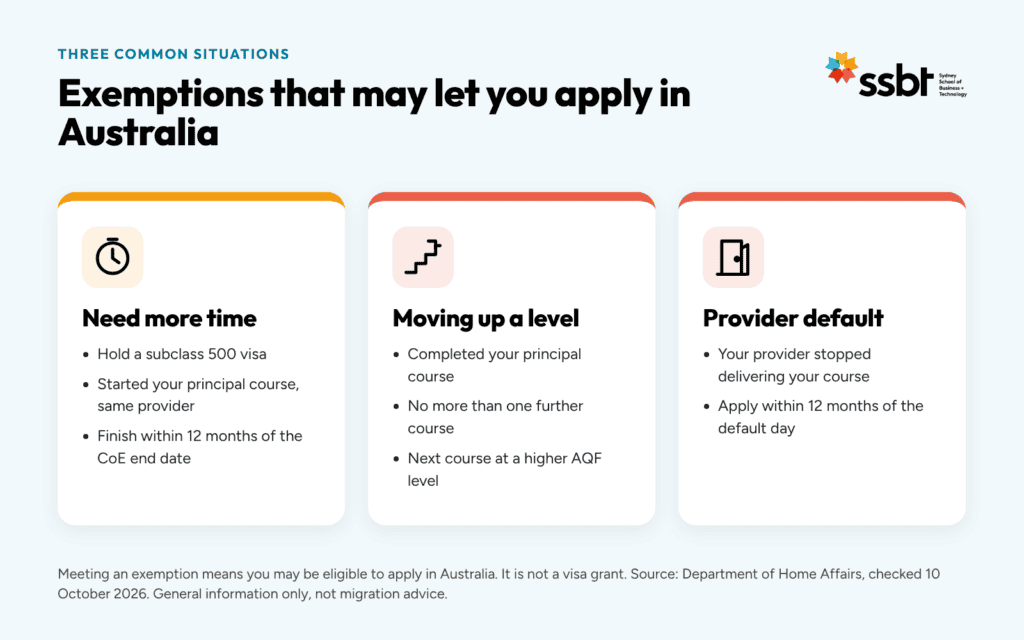
Failing subjects does not, on its own, make you eligible. The completion exemption has three main conditions:

  1. You currently hold a subclass 500 visa.
  2. You have started your principal course, or an eligible alternative course with the same provider. Your principal course is the highest AQF level course in your visa. AQF means the Australian Qualifications Framework, the national system of qualification levels.
  3. You will finish that course within 12 months of the end date on its CoE (Confirmation of Enrolment).

If you are behind, talk to your school first. The academic team can assess whether an adjusted study plan is possible, based on your results and the subjects available.

“I completed my course and want a higher qualification”

The course progression exemption has these main conditions:

  1. You currently hold a subclass 500 visa.
  2. You have completed your principal course or an eligible alternative.
  3. You are enrolled in no more than one further course.
  4. If your completed course has an AQF level, the further course must be at a higher AQF level.
  5. If you completed a higher education course, the next course must also be higher education, delivered by a higher education provider.

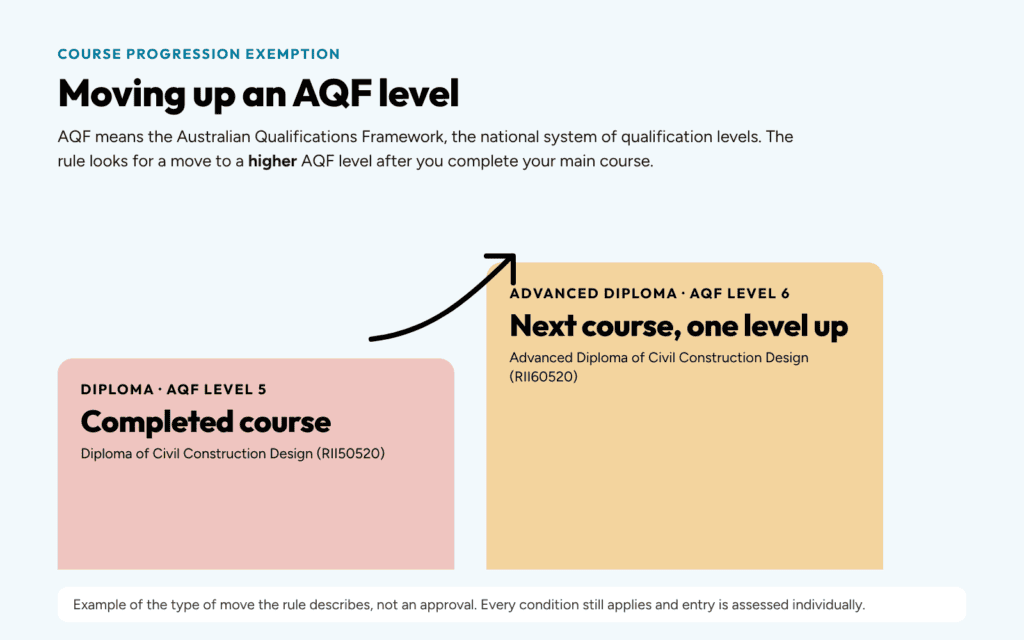
For example, a student who completes the Diploma of Civil Construction Design (RII50520, AQF Level 5) and enrols in the Advanced Diploma of Civil Construction Design (RII60520, AQF Level 6) is moving to a higher AQF level. This is an example of the type of move the rule describes, not an approval. Every condition still needs to be met, and course entry is assessed individually.

A course offer alone does not satisfy every condition.

“My provider stopped delivering my course”

This is called provider default. You may be able to apply in Australia if all of these apply:

  • You were enrolled in the course on the day of the default.
  • You cannot complete the course because of the default.
  • You need a further visa to study an eligible replacement course.
  • You apply within 12 months of the default day.
  • You have not applied before because of the same default.

Deferring your studies or cancelling your own enrolment is not automatically provider default.

Other groups that may be exempt

  • Doctoral students: students enrolled in a doctoral (PhD) degree.
  • School students: students in primary or secondary school.
  • Sponsored students: students sponsored by the Department of Foreign Affairs and Trade (DFAT) or Defence.
  • Non AQF courses: students who completed school and are moving to a course without an AQF level, or who completed a course without an AQF level and are moving to a course with one.

Family inclusion follows separate rules, and these exemptions do not apply automatically to the temporary visa holders described in our guide for temporary visa holders. Read our overview of the changes and our guide for temporary visa holders.

Your action checklist

Gather these before you speak to anyone:

  • Your visa grant notice and expiry date.
  • Your CoE for each course.
  • Your academic transcript.
  • A list of your remaining subjects.
  • Your proposed completion plan or next course plan.

Then talk to us about your academic options. For advice on your own visa eligibility, speak to a registered migration agent or an Australian legal practitioner.

Talk to us

Current SSBT students can book a time with our academic team to discuss their study plan. Contact 02 9249 7800 or info@ssbt.edu.au.

Official sources

  • Department of Home Affairs, Changes to Student visa applications factsheet: immi.homeaffairs.gov.au
  • Department of Home Affairs, Student visa (subclass 500) page: immi.homeaffairs.gov.au
  • Migration Amendment (Student Visa Reform) Regulations 2026 (F2026L01347)
  • Migration (Student Visa Applications to Be Made from outside Australia) Instrument 2026, LIN 26/102 (F2026L01348)
  • Exemptions amendment instrument, LIN 26/087 (F2026L01349)

Legislation is published on the Federal Register of Legislation at legislation.gov.au.

This article is general information, checked on 10 October 2026. It is not migration or legal advice. Rules can change, so check the official sources above before you act. For advice about your own situation, speak to a registered migration agent or an Australian legal practitioner.


Sydney School of Business and Technology (SSBT) · ssbt.edu.au · info@ssbt.edu.au · 02 9249 7800
CRICOS Provider Code 02140E · RTO No. 90438
Student Visa Changes from 2 October 2026: What Students Should Check

Information checked on 10 October 2026. General information only, not migration advice.

At Sydney School of Business and Technology (SSBT), many of our students are planning their next course or their next visa. This guide explains the October 2026 Student visa changes in plain English, so you know what to check before you make a plan.

What has changed

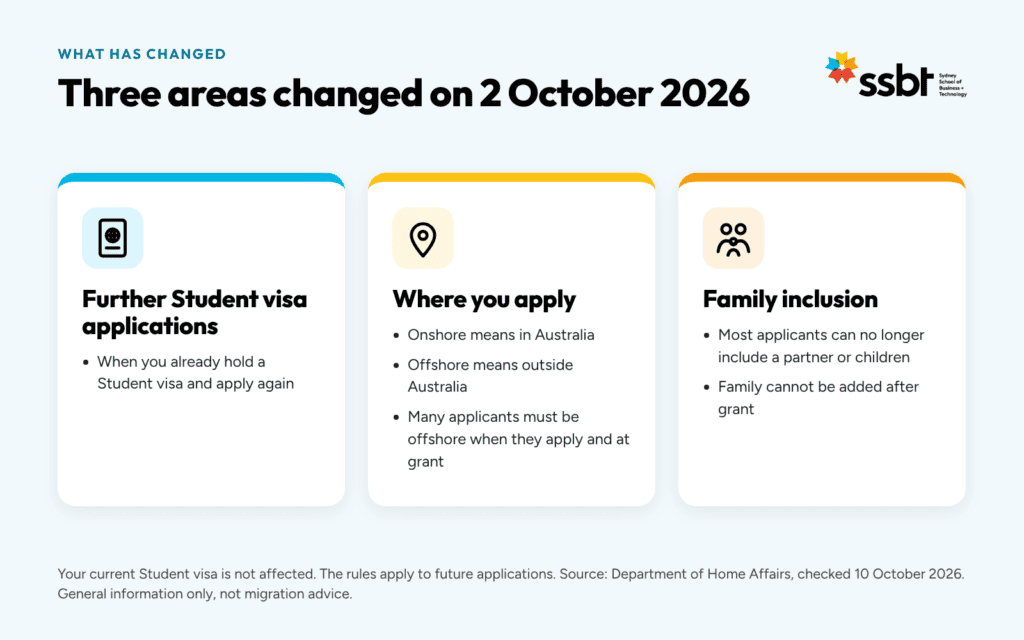
From 2 October 2026, new rules apply to Student visa (subclass 500) applications. They affect three areas:

  • Further Student visa applications, when you already hold a Student visa.
  • Application location, meaning where you are when you apply and when the visa is granted.
  • Family inclusion, meaning whether a partner or children can join your application.

Onshore means in Australia. Offshore means outside Australia.

If the new rules mean you cannot apply onshore, you need to be outside Australia when you lodge your application and also when the visa is granted.

Some limits on applying in Australia already applied to certain visa holders before this date. The new rules extend and replace them.

Who may be affected

  • Current Student visa holders who want to apply for another Student visa.
  • Holders of certain temporary visas who want to study, such as Working Holiday, Visitor and Temporary Graduate visa holders.
  • Applicants who want to include a partner or dependent children.

Holding a temporary visa? Check the affected visa categories and planning steps.

If you hold a Student visa now

Your current Student visa is not affected. The new rules apply when you make a future application.

To get another Student visa, you will generally need to apply from outside Australia unless an exemption applies. Exemptions cover, for example, some students who need more time to finish their main course, some who are moving to a higher level course, and students whose provider stopped delivering their course. Each has conditions.

Need more time to finish, or planning another qualification? Read our guide to the exemptions.

Family members

Separate rules apply to family members.

Most Student visa applicants can no longer include a partner or dependent children. Exemptions exist for some groups, including doctoral (PhD) students, students sponsored by the Department of Foreign Affairs and Trade (DFAT) or Defence, students with a fully funded foreign government scholarship, and eligible students from Pacific or ASEAN countries.

If your family members were already included in your visa or application before 2 October 2026, they may be included in a new application made in Australia, but only if you are eligible to apply in Australia. Family members cannot be added after a Student visa is granted. Home Affairs states there are no exemptions to this rule.

Applications lodged before 2 October 2026

Applications lodged before 2 October 2026 are assessed under the rules in place when they were lodged, including those that included family members.

Before you lodge a new application, check whether you can apply in Australia. Home Affairs advises that a decision that an application is invalid cannot be reviewed by the Administrative Review Tribunal.

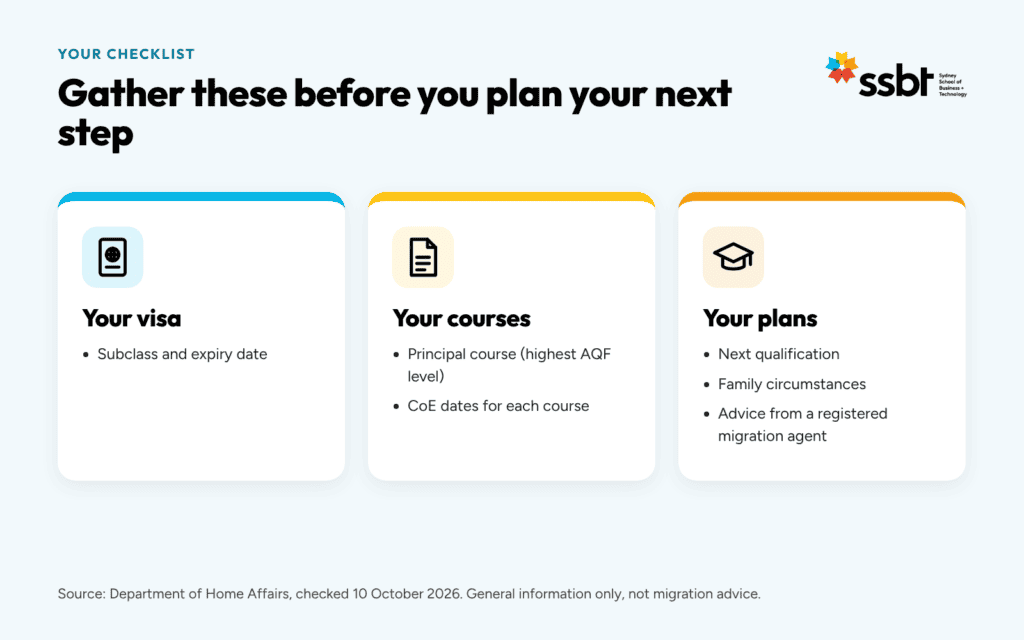
Your checklist

  • Your current visa subclass and expiry date.
  • Your principal course, which is the highest AQF level course in your visa. AQF means the Australian Qualifications Framework, the national system of qualification levels.
  • The dates on your CoE (Confirmation of Enrolment), the document your provider issues for each course.
  • The next qualification you are considering.
  • Your family circumstances.
  • Individual advice from a registered migration agent or an Australian legal practitioner.

Talk to us

Not sure where your studies are up to? SSBT’s student support team can help you check your course dates and plan your next qualification. Contact 02 9249 7800 or info@ssbt.edu.au or visit ssbt.edu.au.

Official sources

  • Department of Home Affairs, Changes to Student visa applications factsheet: immi.homeaffairs.gov.au
  • Department of Home Affairs, Student visa (subclass 500) page: immi.homeaffairs.gov.au
  • Migration Amendment (Student Visa Reform) Regulations 2026 (F2026L01347)
  • Migration (Student Visa Applications to Be Made from outside Australia) Instrument 2026, LIN 26/102 (F2026L01348)
  • Exemptions amendment instrument, LIN 26/087 (F2026L01349)

Legislation is published on the Federal Register of Legislation at legislation.gov.au.

This article is general information, checked on 10 October 2026. It is not migration or legal advice. Rules can change, so check the official sources above before you act. For advice about your own situation, speak to a registered migration agent or an Australian legal practitioner.


Sydney School of Business and Technology (SSBT) · ssbt.edu.au · info@ssbt.edu.au · 02 9249 7800
CRICOS Provider Code 02140E · RTO No. 90438
The 3 Years + 3 Months Graduate Diploma Alternative That Sets You Apart From the Crowd

The international education landscape is changing fast. If you or your students can no longer enroll in the BSB80120 Graduate Diploma of Management (Learning), you might be wondering what the next best pathway is.

We have the solution for you:

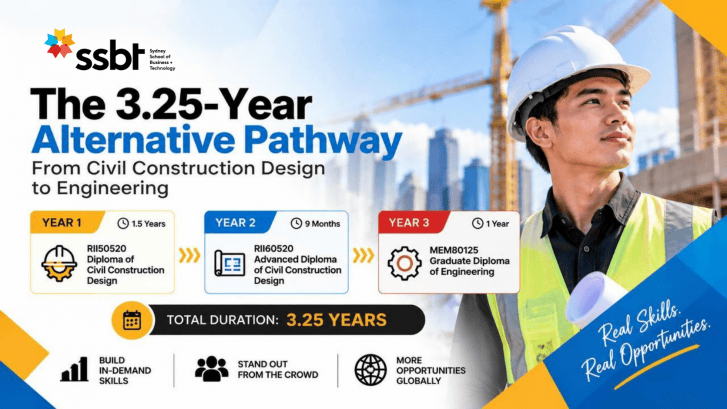
3.25 years alternative pathway that not only fills the gap but gives you a massive competitive edge in the market.

The New Ultimate 3.25-Year Pathway

Instead of a single qualification, students can now package two highly sought-after, more in depth technical qualifications for 3.25 year duration:

  • 1: RII50520 Diploma of Civil Construction Design (1.5 Year) – Still Approved for CRICOS International Students
  • 2: RII60520 Advanced Diploma of Civil Construction Design (9 Months) – – Still Approved for CRICOS International Students
  • 3: MEM80125 Graduate Diploma of Engineering (1 Year) – Still Approved for CRICOS International Students
  • Total Duration: 3.25 Years

Why This Pathway is a Total Game-Changer:

When the market shifts, the best strategy is exclusivity.

Consider this: 449 RTOs across Australia offer the Graduate Diploma of Management. It is a highly crowded, competitive space.

By contrast, only 6 other RTOs nationwide can offer this specific Graduate Diploma of Engineering pathway. By choosing or promoting this course, you are stepping out of a saturated market and into an exclusive, high-value niche with booming industry demand.

Streamlined Entry Requirements: No Prior Engineering Needed

We have made the academic progression as smooth as possible for all students:

  • OPTION 1: Standard GDE Entry: The MEM80125 Graduate Diploma of Engineering (GDE) normally requires applicants to hold an existing Engineering Diploma or Advanced Diploma.
  • OPTION 2: The Packaged Solution: If a student does not hold an engineering background in any field, they do not need to miss out. By enrolling in RII60520 Advanced Diploma of Civil Construction Design + RII50520 Diploma of Civil Construction Design first, they successfully satisfy the prerequisite knowledge needed to transition into the GDE.

*** This means any student looking for a high-level, 3 years + 3 Months qualification can seamlessly transition into this package, regardless of their past study background ***

Ready to Enroll or Partner With Us?

Don’t let market changes slow your momentum. Secure your seats in a high-demand stream that very few providers can offer and email info@ssbt.edu.au  or admissions@ssbt.edu where our friendly team will be waiting to help you!


The 3-Year Graduate Diploma Alternative That Sets You Apart From the Crowd

The international education landscape is changing fast. If you or your students can no longer enroll in the BSB80120 Graduate Diploma of Management (Learning), you might be wondering what the next best pathway is.

We have the solution for you:

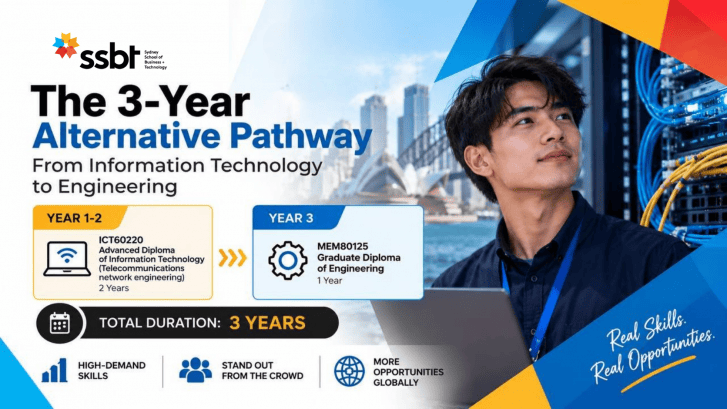
3 years alternative pathway that not only fills the gap but gives you a massive competitive edge in the market.

The New Ultimate 3-Year Pathway

Instead of a single qualification, students can now package two highly sought-after, more in depth technical qualifications for 3 years duration:

  • 1: ICT60220 Advanced Diploma of Information Technology (Telecommunications network engineering) (2 Years) – Still Approved for CRICOS International Students
  • 2: MEM80125 Graduate Diploma of Engineering (1 Year) – Still Approved for CRICOS International Students
  • Total Duration: 3 Years

Why This Pathway is a Total Game-Changer:

When the market shifts, the best strategy is exclusivity.

Consider this: 449 RTOs across Australia offer the Graduate Diploma of Management. It is a highly crowded, competitive space.

By contrast, only 6 other RTOs nationwide can offer this specific Graduate Diploma of Engineering pathway. By choosing or promoting this course, you are stepping out of a saturated market and into an exclusive, high-value niche with booming industry demand.

Streamlined Entry Requirements: No Prior Engineering Needed


We have made the academic progression as smooth as possible for all students:

  • OPTION 1: Standard GDE Entry: The MEM80125 Graduate Diploma of Engineering (GDE) normally requires applicants to hold an existing Engineering Diploma or Advanced Diploma.
  • OPTION 2: The Packaged Solution: If a student does not hold an engineering background in any field, they do not need to miss out. By enrolling in our ICT60220 Advanced Diploma of Information Technology (Telecommunications network engineering) first, they successfully satisfy the prerequisite knowledge needed to transition into the GDE.

*** This means any student looking for a high-level, 3 years qualification can seamlessly transition into this package, regardless of their past study background ***

Ready to Enroll or Partner With Us?

Don’t let market changes slow your momentum. Secure your seats in a high-demand stream that very few providers can offer and email info@ssbt.edu.au  or admissions@ssbt.edu where our friendly team will be waiting to help you!


1 2 3
ssbt logo